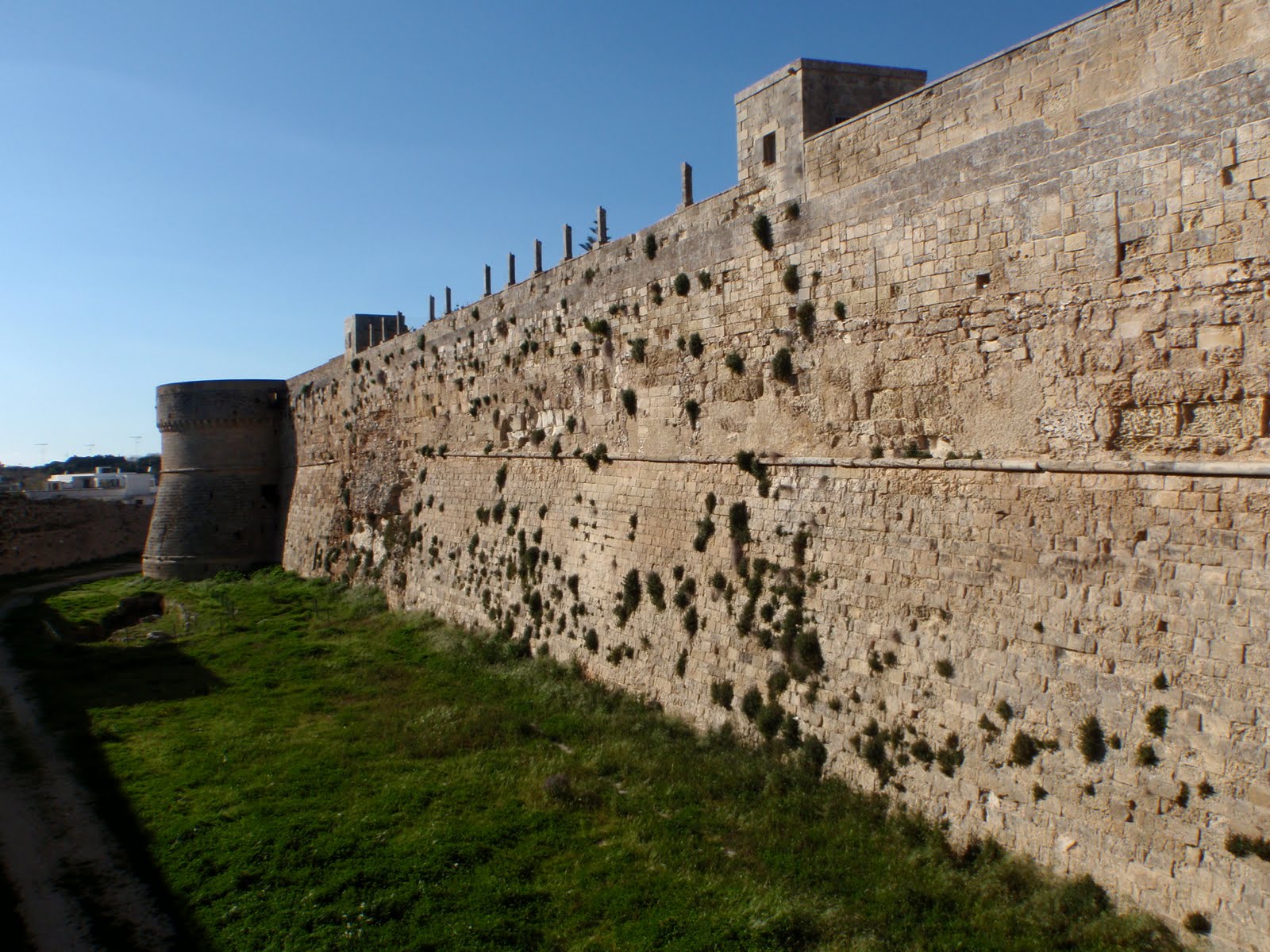
Anne and I took our last bike ride on our Siciclando self-guided bicycle tour by visiting some other seaside towns and a grotto. We ended with an early dinner (we got a bar to take pity on us and serve us food at 6:00pm) and Anne got a nice shot of a full moon over Otranto. One of my pictures is of Anne peeking through the window of a local castle. Also included a couple of pictures of the grotto. Enjoy! Tomorrow we take a taxi ride and plane flight to Florence.
Monday, March 29, 2010
Last day in southern Italy
Anne and I took our last bike ride on our Siciclando self-guided bicycle tour by visiting some other seaside towns and a grotto. We ended with an early dinner (we got a bar to take pity on us and serve us food at 6:00pm) and Anne got a nice shot of a full moon over Otranto. One of my pictures is of Anne peeking through the window of a local castle. Also included a couple of pictures of the grotto. Enjoy! Tomorrow we take a taxi ride and plane flight to Florence.
Sunday, March 28, 2010
ride to Otranto
Anne and I got a van ride this morning, along with our bikes, to the town of Lecci, This reduced our journey to Otranto, a seaside resort town, to 31 miles, It is palm Sunday and we got to observe a street procession by a local church in celebration of the event. There are several large cathedrals in Lecci, so they all had something special going on for the day. We hopped on our bikes and had a pleasant ride with a good tail wind to boost our speed. One of my pictures is of Anne going ahead of me through a tunnel of trees. After our arrival in Otranto, we visited a local castle and then took some pictures of the setting sun giving a good glow to the foliage surrounding a tomb of eight hundred Christian martyrs. The death of the martyrs occurred during a time of Arab control of the region. This is another reminder of how close southern Italy is to the middle east, Africa, and Greece. Northern Italy and southern Italy truly seem like to different countries in their historical ties and resulting cultures.
Saturday, March 27, 2010
Locorotondo, Ostuni
We rode through another trulli city today, Locorotondo, on our way to Ostuni. Anne and I were able to get some pastoral and valley pictures of the trullis along the way. The blooming wild flowers also increase in number as spring progresses, so I could not resist a shot of a field in full bloom. Our final destination, Ostuni, is nicknamed the "white city". It is within a few miles of the Adriatic coast. All the houses in the historic centre are only painted with white lime paint. It was finally warm enough that we could strip down to short sleeves and sit in the sun while eating our typical reward for a completed ride--a cup or cone of gelato. We expect to eat some fresh fish tonight because of the close proximity to the coast. Tomorrow, we are going to spend a full day riding the northern coastline.
Friday, March 26, 2010
Alberobello
After a 43 mile bike yesterday we spent today strolling around the town of Alberobello. Along with Matera, Alberobello is also on the list of UNESCO historical preservation sites because of the uniquely built homes called “trulli” (pronounced “truly”). Our hotel is a trulli and is truly nice (the opportunity for puns throughout the day were truly trying of Anne's patience). I have pictures of the town and a couple of the inside of our hotel. The roofs are made from slabs of limestone carefully split to lay nicely on the roof like shingles. The walls of the homes—also limestone—are up to a meter in thickness to be able to support the weight of the roofs. Lofts were traditionally built into homes to create sleeping quarters for the children. One truly has the feeling that a hobbit or a dwarf will pop out in front of you at anytime :). The historical area of the town gets many Japanese visitors because Japan has a sister city that also has homes made of natural local materials.
Thursday, March 25, 2010
Food, Matera
I guess I have kind of neglected the food element--it is Italy, right? So, here are some food shots/information. The picture of the cappuccino is a work of art done by a barista at an Illy cafe in Matera. You can see “Matera” written on the foam, as well stair steps and the sky. There is also a fine pizza I got last night at a local osteria. Finally, Anne is happily holding up a piece of bread. Why is she so happy? This bread made in Matera is famous for its extraordinary taste, fragrance and digestibility. The flour is obtained exclusively from local types of durum wheat, mostly selected among those descending from the “Cappelli” wheat. Anne, who has gluten allergies, has had no problems digesting this bread. Of course, she is already contemplating how to get the flour from here to home.
Tuesday, March 23, 2010
Catana, Matera
After a couple of days rest in Catana, a university town in Sicily, we took two plane flights and a train ride to Matera in southern Italy. This will be the beginning of our one-week self-guided tour supported by Siciclando. We were issued our bikes and route maps today. Our luggage will be moved for us as we change hotels throughout the tour. Two of the pictures for today are from some gardens in Catana. I posted the one of the cactus because I have never seen one in bloom outside of my home. The other is a “garden clock”, which I thought was pretty clever. The other two pictures are from Matera. Matera is a medieval cave town. The old homes were a collection of cave dwellings and remodeled grottos. An ingenious system of canals regulated the flow of water and sewage throughout the caves to make them successful dwellings until the 20th century. Then the population dramatically increased and overwhelmed the systems. Diseases spread and the infant mortality increased to 50%. The Italian government intervened in the 1950s and moved the town's residents out of the caves into more traditional housing. Now the cave housing has been modernized for preservation and tourism. One of the pictures is the focal point of the town, a duomo sassi. The other is attempt to show the odd mixture of cave material and “tufa” (limestone) that make up the buildings. Of course, Anne happens to be posing in the picture ;)
Friday, March 19, 2010
Taormina
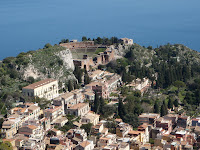
Today we took a tour of the classic Greek theatre in Taormina. It went through many revisions as the city was ruled by the Greeks, Romans, Normans and Byzantines. The Romans did the most damage when they turned it into a gladiator arena. However, the theatre always retained its value by being in a location with beautiful views and and being a wonderful sound chamber by having the sea behind the stage—this allowed the sea breeze to always be pushing the sound to the audience. There is seating for 2,000 people. It is the 2nd largest theatre in Italy. Many famous classical groups and other popular performers have been on this stage. Taormina is the most culturally diverse and well-educated city in Sicily—the tour guide called it “an island within an island”. It was an alternate home for many writers, including Tennessee Williams, Truman Capote, Goethe and Lord Nelson. The pictures today are of the theatre, an apiary horse from a garden donated to Taormina by Lord Nelson's wife, a view from an old castle on a hill above the city and Anne having a drink or two. Well, actually one of the drinks was mine :). We climbed the hill to the castle after the drinks—fortunately, we had no falls. You can see the theatre from the hill picture!
Subscribe to:
Posts (Atom)